

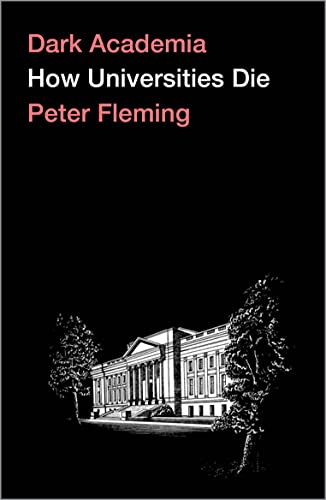
 Reading Dark Academia: How Universities Die by Peter Fleming has ‘stimulated some fundamental questions about the culture of learning and the future of theology’ for James Woodward, which he has written about in his blog. His reflection on different aspects of this, ending with his confidence ‘that Sarum College has a place in recalibrating an ecology of learning where theology has a place in the nurture of wisdom for change and well being’ can be found on his website HERE
- Courses
- Ministry Formation
- Stay, Meet & Eat
- Events Diary
- Join the mailing list
Thank you, James, for this thoughtful and searching piece. Your questions about the future of theology in academic research and teaching resonate deeply. Where I think I may differ from you is in how we diagnose the current culture of higher education. I find myself more persuaded by Fleming’s account of the rise of managerialism, and by Stefan Collini’s earlier warnings (https://www.lrb.co.uk/the-paper/v35/n20/stefan-collini/sold-out and https://www.lrb.co.uk/the-paper/v38/n02/stefan-collini/who-are-the-spongers-now), than by the hope that the new reality can simply be harnessed for good. Reading Collini’s What Are Universities For? and Speaking of Universities after the reforms of the early 2010s shaped my sense that something more fundamental has shifted: universities have increasingly been recast through market logic, with students imagined as consumers and knowledge as a commodity. On that reading, the expansion of metrics and managerial layers is not simply neutral management gone wrong, but part of a deeper redefinition of purpose. This is why so many academics experience contemporary universities as places where critical inquiry and the intrinsic value of learning are squeezed. I share your desire to imagine spaces like Sarum as sites of wisdom and formation, but I think Fleming and Collini help us to see just how far the system has moved, and why theology’s future may depend on resisting — not merely adapting to — this managerial turn.