- Courses
- Postgraduate Study in Christian Spirituality
- Postgraduate Study in Theology, Ministry and Mission
- Sarum College Course in Spiritual Direction
- Discovering Theology: Starting Out
- Exploring Theology: Going Further
- Short Courses
- Guided Independent Research
- Private Stays, Retreats, Study Breaks and Sabbaticals
- Library
- Sarum Papers & Learning Resources
- Sarum College Bursaries
- Ministry Formation
- Stay, Meet & Eat
- Events Diary
- Join the mailing list



Dr Pollyanna Magne – 11 August 2026
In Spiritual Accompaniment people often come seeking to deepen their relationships with friends, family, faith and God. We soon learn that to enhance our relationship with others we first need to understand ourselves better.1 That self-awareness, being able to recognise who we are as a whole person is essential. It means being able to acknowledge the beautiful, the unremarkable and the flawed elements of our fully human selves. In so doing we unlock our ability to respond more honestly to ourselves, to others, to the choices we make and the way we live our lives.
So let’s talk about our ‘selves’. First, there is the authentic you: the unpolished, unedited, real you. Jung called this the ‘self’.2 This self has spent many years being shaped by the world you inhabit. Its core will have formed in your earliest years, between 0-5 years old, and been directly affected by those in closest proximity to you.3 Over time its edges will have been chipped away at, rounded and smoothed by your life experiences, the expected and the unexpected, the joys, the sorrows, the laughter, and the learning that has taken place along the way. Your ‘self’ will be as unique as your fingerprint, because only you have lived your life. No-one else, not even your twin (if you have one) has the same life-experience as you.
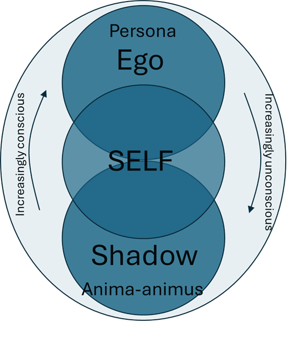 Then there is the persona you project out into the world, your ‘ego’. This is the more polished version of you. Usually the ‘best bits’ that you are happy to share with the world. We present different personas into different spaces, perhaps: the ultimate professional at work; the caring parent at home; the one who gets stuff done in the community; the one who steps in to take the lead when leadership is needed; the funny one who makes people laugh; or the one who stands steadfastly beside another whispering words of encouragement that will get them through a tough day.
Behind each of these is our ego, the part of our self that enables us to put on our ‘best face’, forge relationships and navigate the world around us. The ego is the part of ourselves that we are perhaps most aware of. It is the most visible bit.
Finally, there is the ‘shadow self’ depicted by Jung as parts of a person’s self or psyche that remain hidden, even from ourselves.4 The shadow is the counterweight to the persona that we present to others. It holds parts of ourselves that we consider to be undesirable or even unlovable, such as the ‘pernickety’ or the ‘anxious’ or the ‘angry’ you. And because somewhere along the way these characteristics or behaviours have been depicted as negative, they have been buried. But it happens that some rather wonderful stuff also falls prey to criticism, such as the small child who asks million curious questions; or who expresses their joy through unreservedly loud song; or whose delight in dinosaurs is deemed to be inappropriate and fretful. And this is sad because curiosity, joyous singing and delight are life-enriching, right? For these hidden gems we have another term – the ‘golden shadow’ which encompasses the rather wonderful elements of ourselves that we have also, for some reason, buried deep.5
 It is important to note that, until we begin work on it, we may not even be aware of what may lie in our shadow self – golden or otherwise. Of equal importance is the realisation that our shadow self, all of it, can enrich the way in which we live our lives.
Shadow work requires us to seek out the bits of ourselves that may be hidden away. One way of doing this is to notice what behaviours in others triggers our own negative emotional response. This could be arrogance, impatience, meekness, or indecision. Jung suggests that ‘everything that irritates us about others can lead us to an understanding of ourselves.’6
If, for example, a person dislikes anger, it may because they have locked away their ability to express anger. There will be a reason for this. Perhaps there was too much anger around when they were a child. Maybe that anger was inextricably coupled with flying fists and high tempers. Perhaps, as an adult, it feels safer to bury anger in exchange for a more peaceful existence.
However, all emotions are important. As Hepburn tells us they all need expression, because they facilitate something useful.7 Expression of anger (without the violence) may facilitate release, may bring a clearing of the air, may lead to a new understanding and even a new way forward. Conversely, if anger is suppressed, we may stay stuck where we are.
Another way of seeking out our hidden selves is to highlight the things we like about ourselves and then write a corresponding list of their polar opposites. Jeffrey offers the example of discipline versus laziness.8 Discipline is good, but isn’t it also good to give ourselves permission to rest, to reset, to stop and breathe? Is it possible that challenging and changing your perception of the notion of laziness may change the way that you are able to live life and look after yourself? Might it just save you from burn out?
 Shadow work doesn’t stop there. It invites us to work deeply with those parts of ourselves we have hidden away. We can do this through talking to our shadow-selves. Addressing them directly. Ask them why they are there, why they insist on hiding, what they could offer, how they could change your life and open-up new possibilities. Speak back to them: explain why you have suppressed them; how you might acknowledge them; what they mean to you now; what space you are willing to give them in your life. Remember this work can be risky.9 It is important that for Spiritual Directors to be trained to facilitate shadow-work, so that these questions are placed gently and the dialogue is skilfully guided to a place of acknowledgement, acceptance and growth.
Creative approaches may also unlock ways of expressing, exploring and understanding those parts of us that have remained hidden for years. Unleash your childhood artist. Dance while no-one is watching. Make music. Dig, plant, water and watch something grow. Or just sit quietly, contemplatively with God and let the Holy Spirit work within you.
The intention of shadow work is to gain a better understanding of oneself.10 The aim is to become more integrated, learn ways to manage one’s impulses, strengthen relationships, improve self-esteem and build healthy coping mechanisms. In the Christian context of Spiritual Accompaniment shadow work enables us to know ourselves better, more deeply, more compassionately and more honestly. It enables us to acknowledge our ‘whole-selves’ before God and know, that in our completeness, we are loved.11
References
Erikson, EH. The Life Cycle Completed (Extended Version). 2nd edn. W.W. Norton & Company, 1997.
Jeffry, S., ‘Shadow Work.’ https://scottjeffrey.com/shadow-work/
Hepburn, E. A toolkit for your emotions. Greenfinch, 2023.
Jung, Carl. Memories, Dreams, Reflections. Vintage, 1989.
Jung, Carl. Gustav. The Undiscovered Self: Answers to Questions Raised by the Present World Crisis. Routledge, 2014.
Nouwen, Henri, Michael, J. Christensen, and Rebecca, J. Laird. Spiritual Direction: Wisdom for the Long Walk of Faith. SPCK Publishing, 2011.
Plotkin, Bill. Wild Mind: A Field Guide to the Human Psyche. New World Library, 2013.
St Teresa of Avila. The Interior Castle. Revised. Translated by Mirabai Starr. Penguin Putnam Inc., 2004.
Zweig, Connie. Meeting the Shadow on the Spiritual Path : The Dance of Darkness and Light in Our Search for Awakening. Park Street Press, 2023.
To cite this paper: Magne, Pollyanna. Shadow work: what did your shadow ever do for you? Sarum Papers. 2026
_____________________________________________________________________________________________________________________________________
1 Henri Nouwen et al., Spiritual Direction: Wisdom for the Long Walk of Faith (SPCK Publishing, 2011).
2 Carl Jung, The Undiscovered Self. Answers to Questions Raised by the Present World Crisis (Routledge, 2014).
3 E H Erikson, The Life Cycle Completed (Extended Version), 2nd edn. (W.W. Norton & Company, 1997).
4 Jung, The undiscovered self.
5 Bill Plotkin, Wild Mind: A Field Guide to the Human Psyche (New World Library, 2013).
6 Carl Jung, Memories, Dreams, Reflections (Vintage: 1989), 246.
7 Emma Hepburn, A toolkit for your emotions (Greenfinch, 2023).
8 S Jeffry, ‘Shadow Work,’ https://scottjeffrey.com/shadow-work/
9 Connie Zweig., Meeting the Shadow on the Spiritual Path (Simon and Schuster, 2023)
10 Jung, The Undiscovered Self.
11 St Teresa of Avila, The Interior Castle, Revised, trans. Mirabai Starr (Penguin Putnam Inc., 2004).