- Courses
- Postgraduate Study in Christian Spirituality
- Postgraduate Study in Theology, Ministry and Mission
- Sarum College Course in Spiritual Direction
- Discovering Theology: Starting Out
- Exploring Theology: Going Further
- Short Courses
- Guided Independent Research
- Private Stays, Retreats, Study Breaks and Sabbaticals
- Library
- Sarum Papers & Learning Resources
- Sarum College Bursaries
- Ministry Formation
- Stay, Meet & Eat
- Events Diary
- Join the mailing list


by Michael Hahn
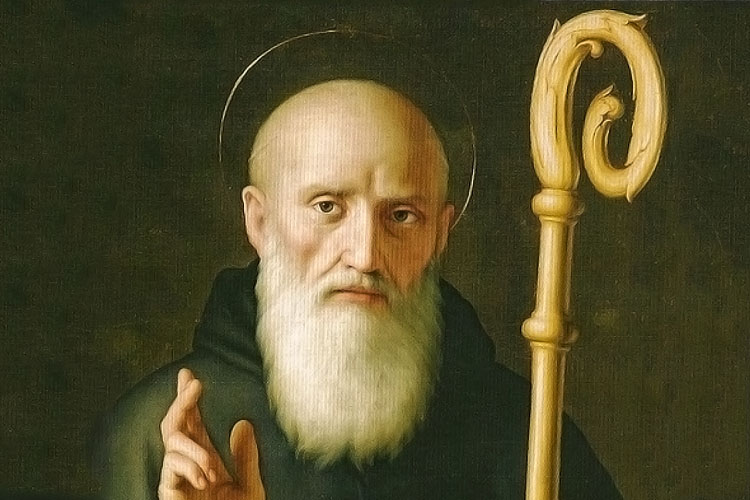
St Benedict’s legacy in Christian theology and spirituality is huge. But what we know about Benedict (d. 547) the man is relatively little, and is largely derived from The Life of Benedict, written a half century after Benedict’s death by Pope Gregory the Great as part of the second book of Gregory’s famous text, The Dialogues. This part of The Dialogues celebrated the achievements of Christian ascetics in Italy. A Life (or a Vita) was a form of writing we call hagiography which presents not so much a biography of a figure but an account of someone’s holiness designed to paint a picture of them as worthy of veneration as a saint. The Life of Benedict, therefore, is difficult to use as a historically accurate account of his life, but it does show us what image of Benedict and his spirituality Christians in subsequent centuries would have had access to.
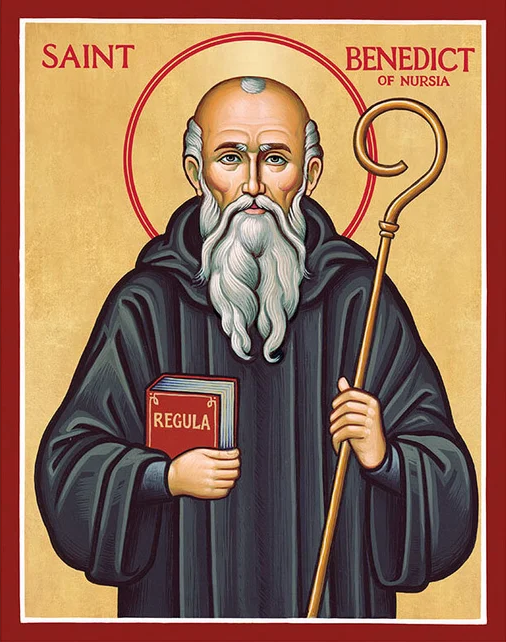
St Benedict of Nursia. Image from: https://www.monasteryicons.com/
Gregory presents Benedict as a holy man as well as a miracle worker. Benedict was born in Norcia (or Nursia) in the region of Perugia – not far from Assisi where seven centuries later, St Francis was born. The young Benedict was sent to Rome to be educated but was shocked by the lifestyles of his fellow students and so fled into the hills to practise an ascetic lifestyle. As often happened throughout Christian history, those who flee into the countryside (or the desert) soon attract attention, and many men gathered around Benedict to receive his instruction in the ascetic life. As the numbers grew, he grouped them into 12 and appointed an abbot for each group. He himself moved to a hill in Monte Cassino where he founded his monastery.
The Life of Benedict makes very little mention of Benedict’s rule, only saying that:
“He wrote a rule for monks remarkable for its own discretion and the lucidity of its language. If anyone wished to know more about his life and conversation, he can find all the facts of the master’s teaching in this same institution of the rule, for the holy man could not teach otherwise than he lived.”
The rule itself – Benedict’s greatest legacy – took its influence from the work of many of the great figures of late-antique and early medieval theology, including John Cassian, Evagrius of Pontus and Augustine of Hippo. The rule has a slightly disordered logic to its structure, leading scholars to suggest that it was likely written over a long period rather than in one go. The “little rule” as Benedict called it was intended for beginners to help them grow into the likeness of Christ.
All monks were required to spend a year as a novice, after which they needed to remain in community under the rule until their death. Roughly speaking, the rule’s 73 chapters can be divided into three sections:
- Prologues and chapters 1-7: the aims and characteristics of the life of the ascetic
- Chapters 8-20: regulations for prayer and readings (which make up the monk’s day through the monastic hours)
- Chapters 21-73: regulations for sleep and work as well as the election of officers
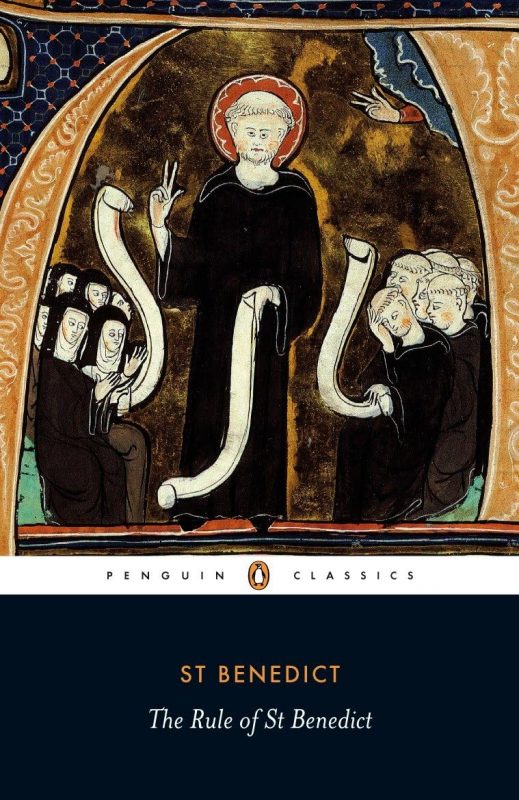
For Benedict, the best life for monks was in community (as “Cenobites”) where life is regulated for the monks by the rule and by an Abbot. For those who are particularly advanced in their spiritual life, life as a hermit (on their own or in small groups) was acceptable, but often this would still be within the network of a monastery.
Although there are many important aspects of Benedict’s rule, three are perhaps particularly famous. The first two make up the famous phrase “ora et labora” (“prayer and work”). The monks’ prayer life would offer a structure for their day, meeting to pray eight times a day (seven in the day and one at night). This involved a structure of hymns, readings and particularly the Psalms. Work would often depend on the monks’ context, but would usually include agricultural work, copying work in Scriptoria, hospitality, and schooling, with monasteries being the main centres of education until the 12th century when Cathedral schools (and then universities) emerged.
Reading was also a central aspect of Benedictine life. This meant monks were encouraged to learn Latin in order to do this (and also to take part in the liturgical life of the monastery). Although contemplative reading was emphasised by earlier writers, Benedict instituted the practice of lectio divina which has become so popular today. This practice was then developed and concretised by the twelfth-century Carthusian monk, Guigo II. Guigo laid out the four steps of lectio:
- Preparing by sitting in silence and reciting a prayer, following by a slow, gradual reading of a scriptural passage. The passage is either picked at random or based on the liturgical calendar, not consciously chosen;
- Meditating on the passage, keeping the mind open to what comes rather than trying to analyse it;
- Prayer as in a dialogue with God;
- Silent prayer to express the love of God.
Benedict’s rule was quickly adapted to be used also by nuns with famous Benedictine women including Benedict’s own sister, Scholastica, and – in the 12th century – Hildegard of Bingen. Against the backdrop of the fall of the Western Roman Empire in 476, the rule and the rise of popularity in monasticism provided some sense of stability. Although having popularity in the early Middle Ages, it is particularly from the ninth century onwards that it becomes the main monastic rule for many religious orders.
In Britain, Augustine of Canterbury founded a Benedictine community in 597. There are notable foundations in Whitby, Durham and Lindisfarne in the last quarter of the eleventh century.