- Courses
- Postgraduate Study in Christian Spirituality
- Postgraduate Study in Theology, Ministry and Mission
- Sarum College Course in Spiritual Direction
- Discovering Theology: Starting Out
- Exploring Theology: Going Further
- Short Courses
- Guided Independent Research
- Private Stays, Retreats, Study Breaks and Sabbaticals
- Library
- Sarum Papers & Learning Resources
- Sarum College Bursaries
- Ministry Formation
- Stay, Meet & Eat
- Events Diary
- Join the mailing list


by Michael Hahn
Although originally written for men, Benedict’s rule was also used widely by nuns and became particularly popular in German territories from the 9th century onwards. Maybe the most famous woman Benedictine is one of the greatest theologians of Christian history, Hildegard of Bingen (d. 1179). Given by her parents to the famous anchoress and ascetic Jutta of Spondheim, Hildegard was, from her teenage years, a nun living attached to the male monastery at Disibodenberg. Hildegard was elected prioress of the women after Jutta’s death and took up a much more moderate approach, as characteristic of the Benedictine rule.
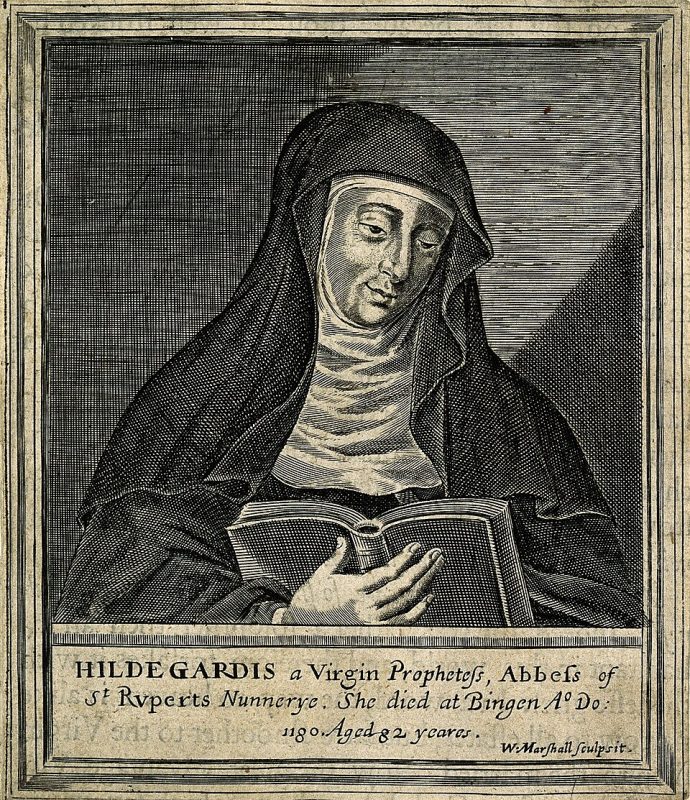
Having experienced visions from the age of 6, they became more intense after being made prioress and God instructed her to write these down with the assistance of her confessor and scribe, Volmar. Hildegard claimed these visions and her understanding of their meaning came directly from God or “the Living Light.” She was politically astute and sent accounts of her visions to a particularly famous theologian of her day, Bernard of Clairvaux who had huge political and ecclesiastical clout. Bernard authenticated her vision accounts and presented them to Pope Eugene who (Hildegard tells us) approved of them too.
With these approvals came much fame. In the mid-1140s, God told Hildegard to move her nuns to an abbey of Rupertsberg (on the Rhine) which she would reconstruct. Hildegard only admitted noble women who she let wear diadems and grow their hair long. When Hildegard was questioned by another Abbess (Tengswich), who challenged Hildegard with Scripture, Hildegard rebutted Tengswich appealing to both Scripture and the Living Light.
As well as her monastic reform, Hildegard is well known for writing in many genres. She wrote three books of visions, Scivias (literally: Know the Ways [of the Lord]), The Book of Life’s Merits, and The Book of Divine Works. Each book was divided into three sections containing several visions alongside explanations and theological and ethical teachings drawn from the vision. Attached to each vision are striking illuminations (colour images), which Hildegard may have had some initial involvement with.
Hildegard wrote many other texts including two scientific and medical works, musical compositions, homilies on the gospels and many letters. What is particularly remarkable is that her theological views were visible across her genres. As such it would be a mistake to extract single aspects of Hildegard’s theology without contextualising it in her wider theological worldview.
For Hildegard, the human person is a microcosm of the macrocosm of creation with parts of the human body, its actions and virtues compared to specific parts of creation, centralising the importance of order and balance for both. The four elements of nature were analogous to the four humours of the person and, for both, when balance is lost, things go wrong. Important to this is her term viriditas, the God-given greening power present in the cosmos and therefore also the human. Meagre after the fall, the reincorporation of viriditas comes through the Incarnation.
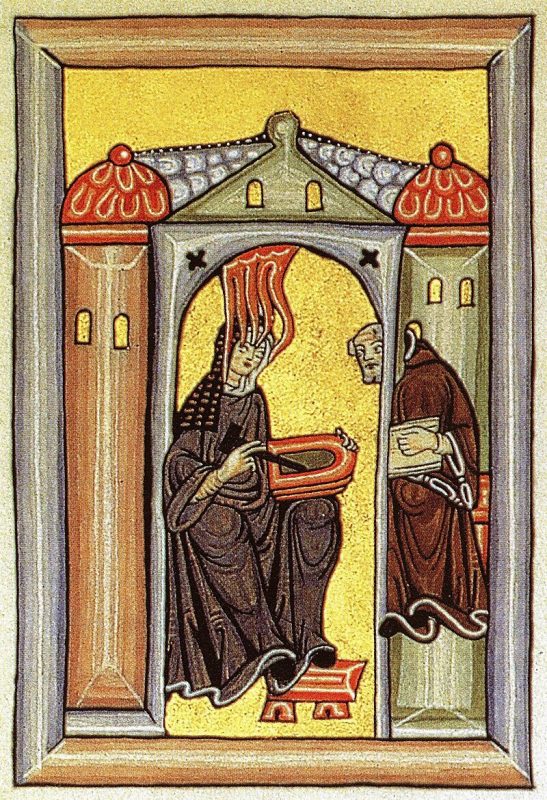
Image from Hildegard’s text, Scivias, depicting her with her scribe, Volmar
For Hildegard, it is the entire Incarnation that is important rather than just the Passion. As such, Mary is particularly important for Hildegard not just to the Incarnation but also salvation. Although orthodox in her view of Original Sin and the Fall, Hildegard’s careful wordplay allows her to lessen Eve’s guilt in the Fall and place Mary as both redeemer of Eve and the completion of Eve’s role.
Hildegard has a substantial legacy. She was used by both Protestant and Catholic reformers to champion their causes, and she was included in the influential Acta Sanctorum (a compilation of saints’ lives) in 1725. Although Hildegard scholarship blossomed in Germany from the mid-19th century, in the Anglophone world, scholarship flourished from the 1980s onwards, with Barbara Newman being a particularly well know figure in this early (and later) scholarship on Hildegard in English.
Today, Hildegard’s life and texts are used in a vast array of contexts, some more and some less faithful to her. Her medical remedies are used in Germany, her writings and reform work engaged with particularly by feminist theologians, and her symphonies are performed and listened to worldwide.
Although Hildegard’s cause for canonisation was opened in the early 13th century, it was not until Pope Benedict (with much encouragement from the nuns in Hildegard’s convent) that Hildegard was made a saint in 2012. Six months later, she was named as one of the 36 Doctors of the Church, alongside only three other women. This celebrates her writing and immense intellect. Although as a 12th-century woman, her writing needed to be in very different genres from those of her contemporaries and 13th-century masters such as Thomas Aquinas or Bonaventure, 850 years later, the Catholic Church officially recognised her as their intellectual equal.